Why "Healthy" Is Not a Property of Food
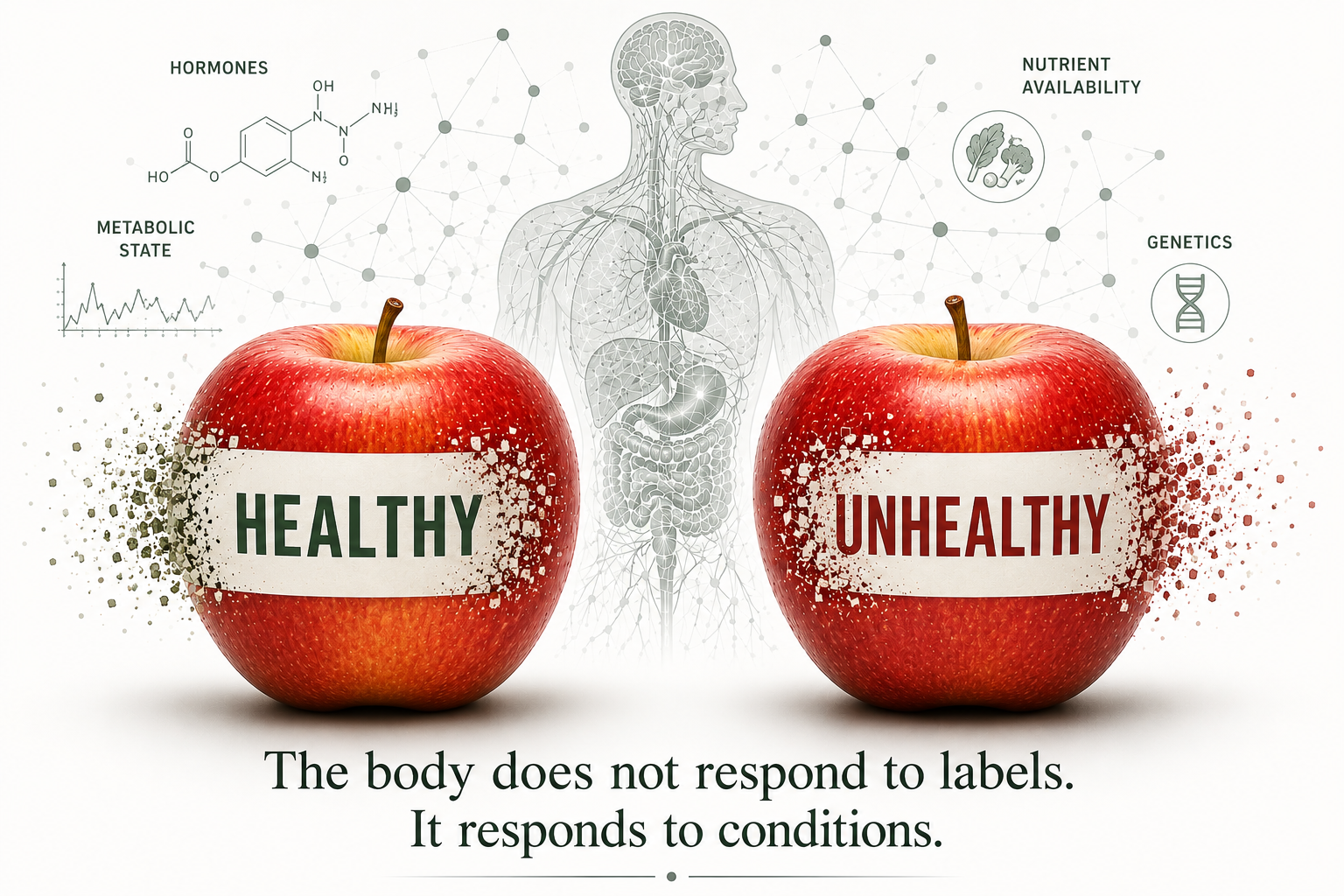
"The body does not respond to labels. It responds to conditions."
Walk through almost any supermarket and you will notice something curious.
Foods are quietly divided into two camps.
Fruit juice is healthy.
Whole grains are healthy.
Low-fat yoghurt is healthy.
Vegetable oils are heart healthy.
Meanwhile, butter, eggs, red meat and full-fat dairy often find themselves on the opposite side of the divide.
These labels have become so familiar that most of us rarely stop to question them. We speak of foods as though "healthy" and "unhealthy" were permanent properties, carried by the food itself regardless of who eats it or under what circumstances.
Yet biology does not work that way.
Human physiology does not recognise foods according to marketing categories. It responds to molecules, hormones, metabolic state, nutrient availability and countless interacting regulatory signals.
In other words, the body responds to conditions.
Context changes everything
Water is essential for life.
Yet excessive water intake can become dangerous.
Oxygen sustains aerobic metabolism.
Yet excessive oxidative stress contributes to cellular injury.
Iron is indispensable for oxygen transport.
Yet excessive iron accumulation damages tissues.
No one finds these statements controversial because they are obviously true. We instinctively recognise that biology is governed by context.
Curiously, this reasoning often disappears when we begin talking about nutrition.
Foods are frequently described as though they exist outside these same biological rules.
Consider fruit juice
Fruit juice is commonly marketed as a healthy food.
After all, it comes from fruit.
But removing the fibre fundamentally changes the physiological experience.
Sugar that would otherwise have been consumed slowly alongside chewing, fibre and greater satiety can now be consumed rapidly in liquid form.
The label remains the same.
The physiology does not.
Smoothies are more complicated than many people realise
Many people assume smoothies solve this problem because the fibre remains.
I used to think exactly the same.
If someone had suggested to me years ago that a smoothie could deliver a considerable sugar load, I would probably have replied:
"Yes, but it's natural"
That response illustrates one of the most common misconceptions in modern nutrition.
Blending several portions of fruit fundamentally changes the eating experience. Much larger quantities can now be consumed quickly, with substantially less chewing and reduced satiety, despite the ingredients remaining identical.
The ingredients have not changed.
The physiological experience has.
"Natural" is not the same as "healthy"
One of the most persistent assumptions in nutrition is that natural automatically means healthy.
It sounds sensible.
It feels intuitive.
But biology does not recognise such a distinction.
Human physiology responds to molecular structure, dose, metabolic context and the condition of the organism.
Whether a substance originated in a plant, an animal or a laboratory tells the body remarkably little.
Nature contains countless toxins.
Cyanide is natural.
Ricin is natural.
Many poisonous mushrooms are natural.
Equally, modern medicine contains countless synthetic compounds that have transformed healthcare and saved millions of lives.
Origin alone tells us very little about physiological value.
Natural simply describes where something came from.
It does not predict what it will do inside the human body.
Healthy compared with whom?
Perhaps the biggest problem with labelling foods as healthy is that it ignores the person eating them.
A metabolically healthy athlete may tolerate a carbohydrate-rich meal with little difficulty.
Someone with severe insulin resistance may experience a completely different physiological response to the very same meal.
The food itself has not changed.
The physiology of the individual has.
This is why blanket nutritional labels inevitably begin to fail.
The real question
Instead of asking,
"Is this food healthy?"
perhaps we should ask,
"How will this food interact with the physiology of the person eating it?"
That is a far more biologically meaningful question.
It recognises that metabolism is not governed by simple labels but by complex, adaptive systems responding continuously to changing internal conditions.
Healthy is not a property carried by food.
It is a description of the interaction between the food and the organism.
And that interaction is always conditional.
That single shift in perspective moves nutrition away from labels and towards physiology, from classification towards understanding.