Weston Price and the Great Nutritional Transition
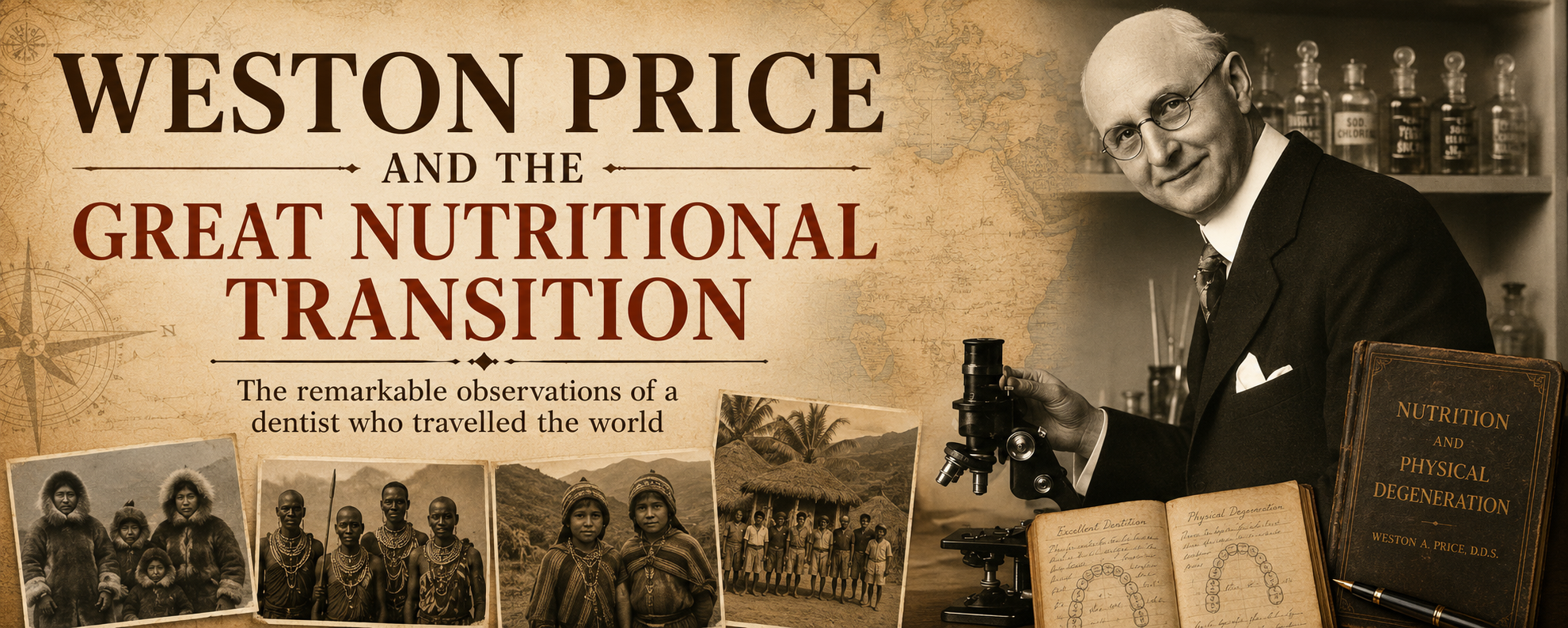
Nearly a century ago, a Canadian dentist set out to answer what appeared to be a remarkably simple question.
Why had tooth decay become so common?
Weston A. Price had spent years treating patients whose dental health seemed to deteriorate with every passing generation. Cavities were becoming increasingly common, facial development appeared to be changing, and many of the children he examined seemed less physically robust than historical descriptions suggested had once been the norm. Rather than accepting these observations as inevitable, Price began to wonder whether something far larger was taking place.
The answer, he believed, could not be found within the walls of a dental surgery.
It would require travelling the world.
Beginning in 1931, Price undertook an extraordinary series of expeditions that would eventually take him to some of the most geographically isolated populations then remaining. He visited Inuit communities in the Arctic, indigenous peoples of North America, pastoral tribes in Africa, Gaelic communities in the Outer Hebrides, Australian Aboriginal groups, and agricultural societies high in the Peruvian Andes.
His aim was deceptively straightforward.
He wanted to observe populations whose traditional ways of life had remained largely untouched by the rapidly expanding industrial food environment.
What he found was both surprising and deeply challenging.
No Single Traditional Diet
One of the most striking aspects of Price's work is the extraordinary diversity of the diets he encountered.
The Arctic Inuit consumed diets dominated by marine mammals, fish and wild game.
East African pastoralists relied heavily upon milk, meat and blood.
Scottish islanders lived largely on oats, seafood and fish.
Communities in the Andes depended substantially upon maize, beans and locally raised livestock.
Australian Aboriginal populations adapted to an enormous variety of native plants and animals according to geography and season.
From a modern nutritional perspective, these diets appear radically different. Their proportions of carbohydrate, fat and protein varied enormously. Their food sources reflected local climate, ecology and tradition rather than any universal nutritional prescription.
If human health depended upon one ideal macronutrient ratio, these populations should have displayed profoundly different patterns of health.
Price repeatedly observed the opposite.
Across communities separated by thousands of miles, speaking different languages, practising different cultures and consuming remarkably different traditional diets, he consistently described broad facial development, well-formed dental arches, low rates of dental decay and impressive physical robustness.
The details differed.
The overall pattern did not.
The Transition That Repeated Itself
The most important observation was not the health of these traditional communities.
It was what happened when their food environments changed.
As refined flour, white sugar, polished grains, canned foods and other manufactured products became increasingly available, Price documented remarkably similar changes regardless of where he travelled.
Dental decay increased.
Facial development changed within a generation.
Dental arches became narrower.
General physical vitality appeared to decline.
In several communities he also described increasing susceptibility to infectious diseases, including tuberculosis.
Importantly, these changes occurred among populations whose traditional diets had previously differed enormously.
The common denominator was no longer the food they had eaten for generations.
It was the industrial food environment replacing it.
A Natural Experiment on a Global Scale
Modern nutritional science has advanced enormously since Price published Nutrition and Physical Degeneration in 1939.
Today we understand endocrine regulation, metabolism, inflammation, mitochondrial biology and molecular physiology in ways that were impossible during his lifetime.
Many of the mechanisms that Price could only speculate about are now active areas of scientific research.
Perhaps equally important, epidemiology has confirmed that the nutritional transition he documented did not remain confined to isolated communities.
As countries industrialised throughout the twentieth century, traditional dietary patterns across much of the world gave way to increasingly processed food environments. Researchers have since described this phenomenon as the nutrition transition—a population-wide shift accompanied by rising rates of obesity, type 2 diabetes and other chronic metabolic diseases.
In this respect, Price's expeditions can be viewed as an early record of a process that would later become global.
Why These Observations Still Matter
It is neither necessary nor scientifically justified to conclude that every traditional dietary practice should be recreated today.
Nor does Price's work demonstrate that there is a single ancestral diet appropriate for every human population.
In many ways, it suggests the opposite.
Human beings appear capable of maintaining excellent health across a remarkably broad spectrum of traditional dietary patterns.
What those environments shared was not an identical balance of carbohydrate, fat or protein.
They shared an absence of highly refined industrial foods and a reliance upon locally adapted, minimally processed, nutrient-dense sources of nourishment.
That distinction remains as relevant today as it was almost a century ago.
We now live in a world where the nutritional transition that Price documented has become the dominant dietary environment for much of humanity. The isolated communities he visited have largely disappeared, but the biological questions raised by his observations remain remarkably current.
How does the industrial food environment influence long-term metabolic health?
Why do populations consuming vastly different traditional diets often experience similar patterns of chronic disease following nutritional westernisation?
And what does this reveal about the relationship between modern food environments and the growing global burden of metabolic illness?
These are questions that continue to shape nutritional science today.
They are also questions that deserve far more attention than they often receive.